Compare one sheer topper over two supported base colors
A sheer topper has a relationship with the color underneath it. Explore that relationship with two conventional-lacquer base shades and one compatible topper. Keep the sequence controlled so the result teaches something about layering rather than becoming an unrepeatable stack of unrelated products.
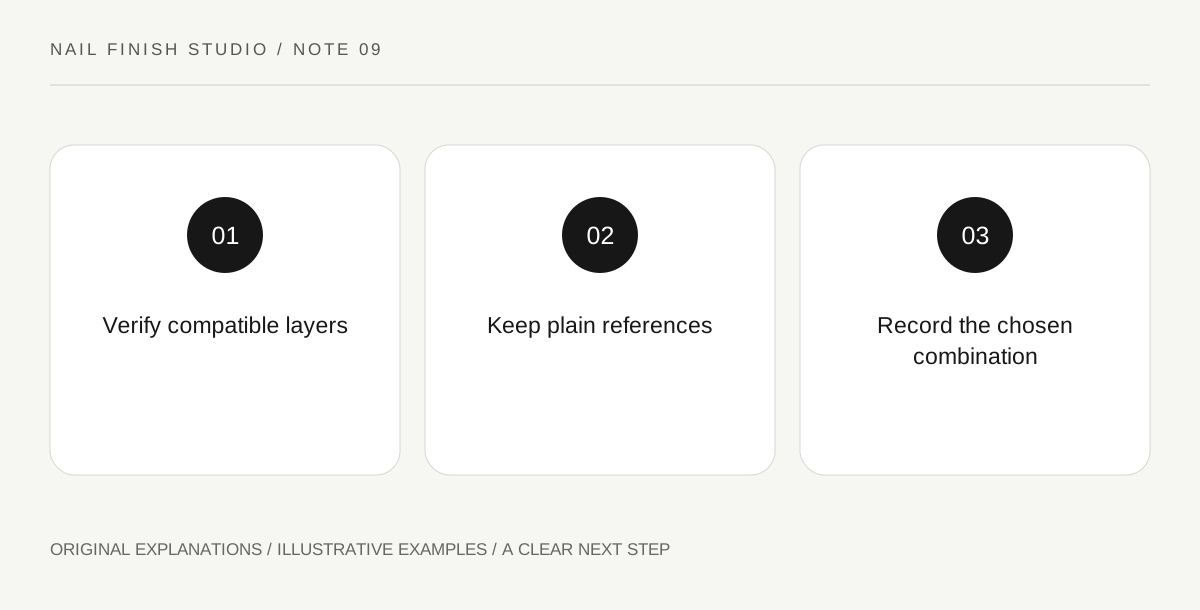
Original explanatory diagram. Read the full method and limitations below.
Confirm that the combination is supported
Identify the product category of the base, color and finish. Read their directions and compatibility guidance before layering. A shared brand name does not necessarily make every system interchangeable. OPI describes a particular sheer topper over a cream in its named collection; that is a bounded manufacturer example rather than permission to combine any lacquer, gel or powder. Use the supported method for the exact products in your exercise.
Choose bases that answer a clear question
Select two shades with a meaningful difference, such as light and dark or warm and cool. Keep other features similar where possible. Write what you want to learn: whether the topper adds a subtle sheen to the pale base or creates a stronger contrast on the dark one. If both bases and toppers change at once, a dramatic result may be attractive but will be harder to understand and repeat.
Preserve a plain reference for each base
Make an untopped reference beside the completed layered version. Label each sample immediately. The reference shows whether the topper changed apparent color, reflectivity or background visibility. Look at ordinary distance and during a slow turn. Do not describe a complete color transformation if the main change is a highlight visible only at one angle. Accurate observation helps you decide where the effect belongs in a final design.
Choose a repeatable final combination
Record the precise products, supported sequence and finish used. Keep the favorite sample with the plain reference so the reason for the choice remains visible. Limit the final manicure to the combination you have actually rehearsed. Extra layers added spontaneously can change thickness, drying and removal requirements. The best outcome of this exercise is a known relationship you enjoy, not the largest possible number of products on one surface.
Illustrative worked example
Illustrative scenario: a learner compares a compatible shimmer topper over a pale peach and a deep brown. Each base also has a plain reference. The peach gains a quiet sheen, while the brown shows a more distinct reflective contrast. The learner chooses the brown combination for one design and records the product sequence. The exercise produces two useful options without treating the topper as a universally identical effect.
Questions that come up
Can I skip the plain reference?
You can, but it becomes harder to identify what the topper changed. A small reference often teaches more than making several extra decorative samples.
Should the topper cover every nail?
Choose according to the visual role. A single repeated accent or a complete finish can both work; compare the arrangement before committing to the full set.
References and scope
These sources support the factual background. Examples and exercises are original illustrative teaching material. References do not imply endorsement.
- FDA: Nail Care Products — Follow labels and warnings, provide ventilation and handle potentially flammable nail products safely.
- OPI: gLITter Nail Lacquer — A manufacturer describes a particular sheer shimmer topper and its supported lacquer layering system.