Observe a shimmer lacquer through movement instead of one still image
Shimmer is a moving relationship between color and reflected light. A still photograph may emphasize only one part of it. Use a conventional-lacquer practice swatch to see how the finish behaves as the viewing angle changes, then decide whether it should lead or quietly support the design.
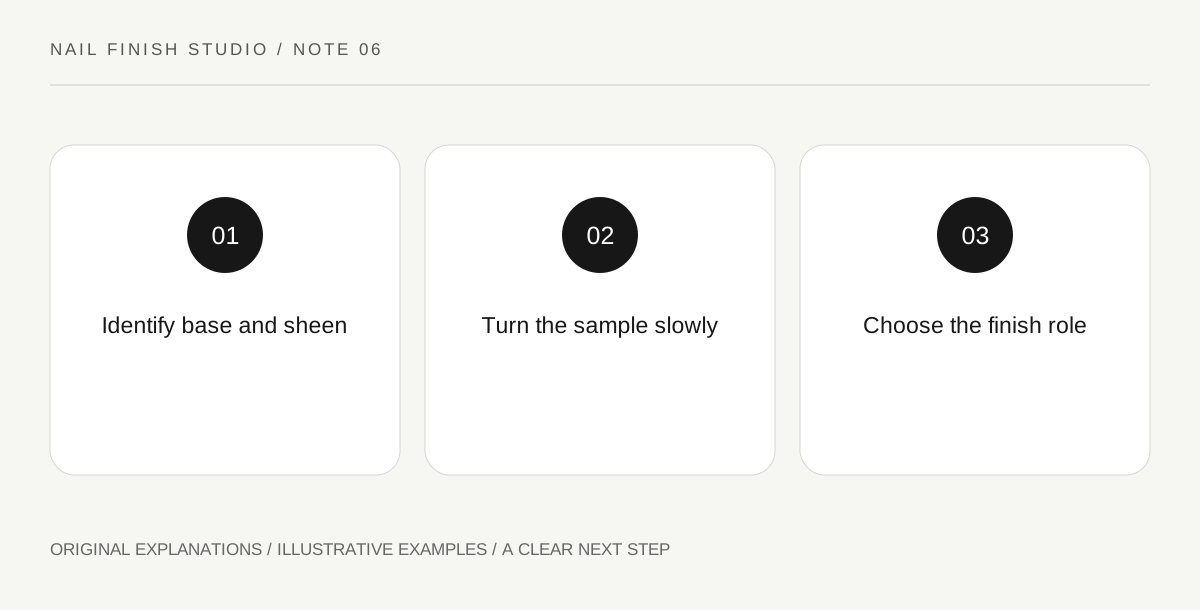
Original explanatory diagram. Read the full method and limitations below.
Separate the base color from the reflection
Look first at the part of the swatch away from the brightest highlight. Describe the underlying color in ordinary terms. Then observe the reflective particles or sheen without assuming they have the same color as the base. A polish can look restrained when stationary and more animated when the hand moves. Keep both impressions in your note instead of treating the most dramatic angle as the complete identity of the finish.
Use a short repeatable movement
Hold the swatch securely and turn it slowly through a small range under ordinary room lighting. Observe where the reflection appears, how broad it becomes and whether the underlying color remains readable. Repeat the same movement beside another sample if comparing products. Do not make a performance claim from this exercise. It is a visual comparison under stated conditions, not a measurement of particle content, durability or optical quality.
Decide the shimmer's design role
A lively shimmer may supply enough detail without a painted motif. Try the sample beside a simple outfit material or a plain color swatch and notice whether the surface already feels complete. If you add another feature, give it a specific purpose rather than assuming a finish needs decoration. OPI's named sheer shimmer topper illustrates one supported layering concept, but the brand's directions apply to that system and should not be generalized to unrelated products.
Document more than the brightest frame
If photographing the sample, retain one ordinary view and a second that shows the reflection. Label the lighting rather than presenting the brightest moment as a constant appearance. Avoid heavy editing that changes the base color. Keep a short written note about how the finish behaves during movement. That description can remain useful when a single image fails to capture the surface you actually enjoyed.
Illustrative worked example
Illustrative scenario: a learner expects a pale shimmer to look sparkling all the time because of an advertisement. Their practice swatch appears quiet when viewed straight on and develops a soft reflective band as it turns. They prefer that subtle change and omit a planned motif. Their note preserves both views, making the finish easier to choose later without promising that every room produces the same effect.
Questions that come up
Is stronger shimmer automatically more effective?
Choose the amount of visual activity that suits the design. A quieter effect can be intentional, especially when clothing or jewelry already supplies strong detail.
Can I add loose craft shimmer?
Use only nail products and combinations intended and supported for that use. Craft materials may have unsuitable ingredients, particle characteristics or removal requirements.
References and scope
These sources support the factual background. Examples and exercises are original illustrative teaching material. References do not imply endorsement.
- FDA: Nail Care Products — Follow labels and warnings, provide ventilation and handle potentially flammable nail products safely.
- OPI: gLITter Nail Lacquer — A manufacturer describes a particular sheer shimmer topper and its supported lacquer layering system.