Build a swatch index that answers a color question quickly
A ring of unlabeled practice tips can become another confusing collection. Build an index around the questions you actually ask: coverage, undertone, reflection or a supported layer combination. Keep it small, accurately labeled and connected to the physical products rather than treating it as a perfect digital color catalog.
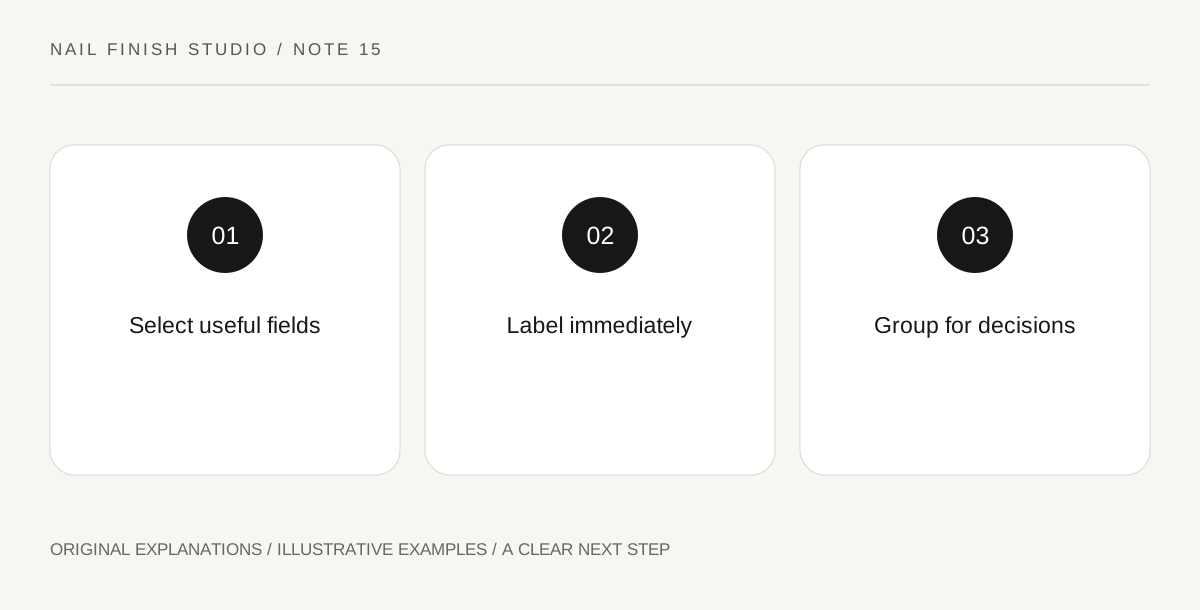
Original explanatory diagram. Read the full method and limitations below.
Choose a limited set of useful fields
Record product name, product category, supported sequence, preparation surface and date. Add the finish and the specific observation that matters. Too many empty fields make the index cumbersome, while too little identity makes a beautiful sample impossible to reproduce. Distinguish a plain color from a layered combination visibly. If a product is no longer usable or available to you, mark that status instead of allowing the sample to imply a ready option.
Label before similar colors accumulate
Write the identifier as soon as a swatch is made. Several pale pinks or near-black shades can become difficult to distinguish once removed from their bottles. Keep the label legible and avoid relying only on a photograph. A short reference number can connect a small tip to a fuller note, but the system should still be understandable after several weeks away. Simple labels are more durable than a code you must relearn each time.
Group by the decision rather than prestige
Arrange samples by the question you want to answer. A coverage group might contain translucent and opaque whites; a reflection group might compare similar colors in cream and shimmer finishes. Brand order can be useful for inventory, but it may not support visual choice. Keep ordinary lighting available for comparison and note when a sample's appearance depends strongly on movement. The index should help select a finish, not rank brands without evidence.
Maintain the relationship with real products
When a bottle changes condition, follow its care and disposal guidance rather than assuming the old swatch proves it remains usable. Retire ambiguous samples or label their limitations. Photographs can back up the labels, but camera processing means they are imperfect color references. Review the index occasionally and remove redundant records that obscure useful comparisons. A modest trustworthy set is more valuable than a large archive full of unidentified layers.
Illustrative worked example
Illustrative scenario: a learner owns six similar pale lacquers and repeatedly chooses by bottle color. They label supported swatches with product identity and group them by coverage. Two transparent samples become easy to distinguish from four more covering ones. A layered sample receives its own sequence note. The index now answers the learner's main question without pretending to measure exact color values or product quality.
Questions that come up
Should I photograph every sample?
Photographs can support identification, but they should not replace physical comparison for subtle color or finish choices. Keep the labels useful on their own.
Can an old swatch prove a bottle is still good?
No. Assess the actual product using its instructions and condition. A preserved sample records a past application, not a current safety or performance guarantee.
References and scope
These sources support the factual background. Examples and exercises are original illustrative teaching material. References do not imply endorsement.
- FDA: Nail Care Products — Follow labels and warnings, provide ventilation and handle potentially flammable nail products safely.
- Essie: Arctic Jelly — Manufacturer description of a sheer buildable white jelly finish, not independent performance verification.
- OPI: gLITter Nail Lacquer — A manufacturer describes a particular sheer shimmer topper and its supported lacquer layering system.