Read the product category before trusting a familiar shade name
A shade name can appear across several nail-product systems. Before buying, borrowing or applying it, identify the actual category and instructions on the bottle. Color familiarity is useful for choosing a look, but it does not establish the same application, curing or removal process.
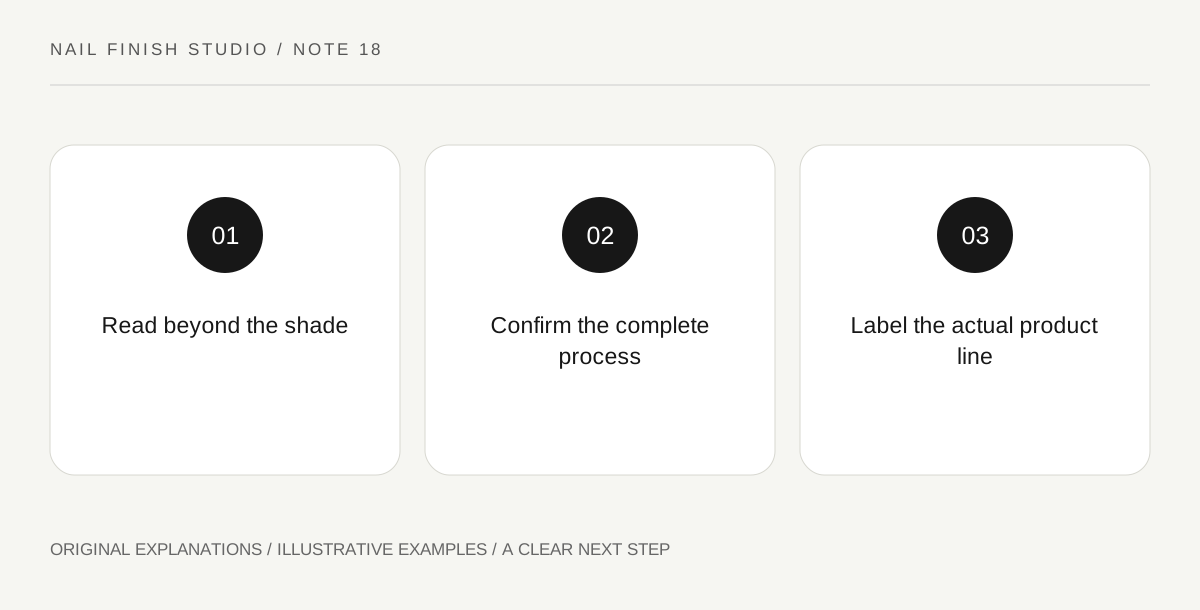
Original explanatory diagram. Read the full method and limitations below.
Find the product system on the label
Read beyond the large shade name to the category, manufacturer and intended use. Conventional lacquer, gel products and other professional systems can require different equipment and handling. A color match is not a process match. Keep the original packaging and instructions where they can be consulted. If a borrowed bottle has no legible identity, do not infer the product type from its shape, cap color or what the owner remembers calling it.
Check application and removal together
Before choosing the color, read how the product is applied and removed. Confirm whether the process fits your equipment, skill and available time. This site's exercises concern conventional air-drying lacquer, so a similarly named product requiring a different system falls outside the exercise. Do not replace a stated curing or removal step with a household shortcut. If the description and label appear inconsistent, resolve that question with the manufacturer or seller first.
Separate marketing words from instructions
Terms such as gel-like, glassy, chrome-looking or salon-inspired may describe an appearance rather than a complete technical system. Essie explicitly says its named Nail Art Studio jelly and effects range does not need a UV lamp; that bounded statement cannot be extended to every product using similar language. Look for the actual directions and warnings. A finish adjective helps describe the result but cannot safely carry the entire meaning of the product category.
Keep the identity with the swatch
Label your practice sample with the full product line as well as the shade. If you later replace a bottle, check the new one rather than assuming the old swatch record supplies its directions. Avoid decanting products into ambiguous containers or removing information simply to make storage look uniform. Clear identity makes it easier to follow the appropriate instructions, report a problem and reproduce a supported visual sequence.
Illustrative worked example
Illustrative scenario: a learner recognizes a favorite shade name in an online listing and nearly assumes it is the same conventional lacquer they own. Reading the line name reveals a different product system. They return to the intended category and verify the label before buying. Their swatch index now records both shade and line, preventing a familiar color name from becoming an unsupported application instruction.
Questions that come up
Does gel-like always mean a UV lamp is needed?
No universal conclusion follows from that adjective. Read the exact product directions; it may describe appearance, while other products genuinely require a specific curing system.
Can the same shade look identical across systems?
A shared name may indicate an intended color relationship, but finish, application and appearance can differ. Compare actual supported samples rather than assuming identity from the name alone.
References and scope
These sources support the factual background. Examples and exercises are original illustrative teaching material. References do not imply endorsement.
- FDA: Nail Care Products — Follow labels and warnings, provide ventilation and handle potentially flammable nail products safely.
- Essie: Nail Art Studio — This named conventional jelly/effects range does not require a UV lamp; not a statement about all similarly named products.