Prepare the next half hour before opening a lacquer bottle
A carefully painted manicure can be disrupted by a phone hidden in a bag or a door that still needs unlocking. Prepare the surrounding routine before application. This is a workflow exercise for conventional air-drying lacquer, with drying and handling times determined by the actual products.
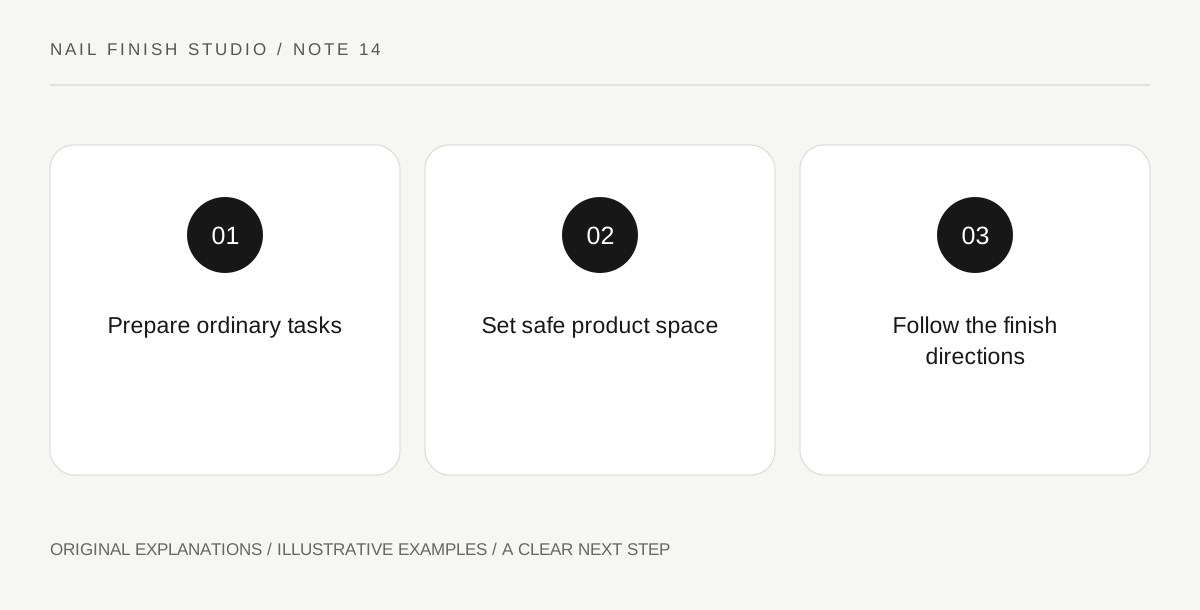
Original explanatory diagram. Read the full method and limitations below.
List the tasks that will demand your hands
Think through the period after application: answering a message, using keys, changing clothes, preparing food or leaving the room. Complete or rearrange what you reasonably can before beginning. Do not use a fixed promised drying time as permission to schedule a rush. Different products and application sequences have their own guidance. The useful preparation is identifying avoidable handling, not trying to immobilize yourself for an arbitrary number of minutes.
Set a safe working surface
Place products on a stable protected surface with suitable ventilation, away from flames and heat sources. Keep children and pets from the supplies, and arrange a clear way to close and store bottles when finished. Put only the necessary compatible products within reach. A crowded tabletop increases the chance of knocking over an open container. Avoid setting up beside food preparation or an ignition source simply because the lighting is convenient.
Read the entire finish sequence
Know what follows the color stage before applying it. A topcoat, drying agent or other named product has its own directions; the category name does not provide universal timing or compatibility. OPI's RapiDry page supplies instructions for that specific product, illustrating why the actual system matters. Do not add household heat, ice or improvised chemicals to speed the process. Plan enough time to follow the supported method without pressure.
Make the ordinary activities easy to postpone
Choose a comfortable location and keep a low-handling activity ready if desired. Arrange water and essential belongings beforehand without creating a precarious setup. If an urgent need arises, attend to it; a cosmetic finish is not a reason to delay something important. Afterward, record which interruption recurred so the next session improves one practical detail. A repeatable calm routine is more useful than a collection of elaborate drying tricks.
Illustrative worked example
Illustrative scenario: a learner finishes painting and immediately needs keys at the bottom of a zipped bag. For the next session they unlock the necessary door, place keys safely and change clothes first. They read the finish instructions before starting and allow an unhurried window. The improvement concerns preparation; they make no claim that the lacquer dried faster or became resistant to damage at a particular minute.
Questions that come up
Does touch-dry mean every activity is safe?
Use the manufacturer's guidance for the exact product and sequence. A quick surface impression does not create a universal guarantee about pressure or handling.
Can a hair dryer speed things up?
Do not improvise heat around potentially flammable products. Follow the supported drying process and create sufficient time instead of adding a household shortcut.
References and scope
These sources support the factual background. Examples and exercises are original illustrative teaching material. References do not imply endorsement.
- FDA: Nail Care Products — Follow labels and warnings, provide ventilation and handle potentially flammable nail products safely.
- OPI: RapiDry Top Coat — Application is product specific; drying-agent and topcoat names do not supply universal timing.