Find a real gap in a lacquer collection before buying another similar shade
A new polish can feel different in its bottle yet duplicate a finish already available at home. Review the collection through the looks you actually choose. A gap should describe a useful visual role or supported process, not simply an empty space in an imagined perfect color spectrum.
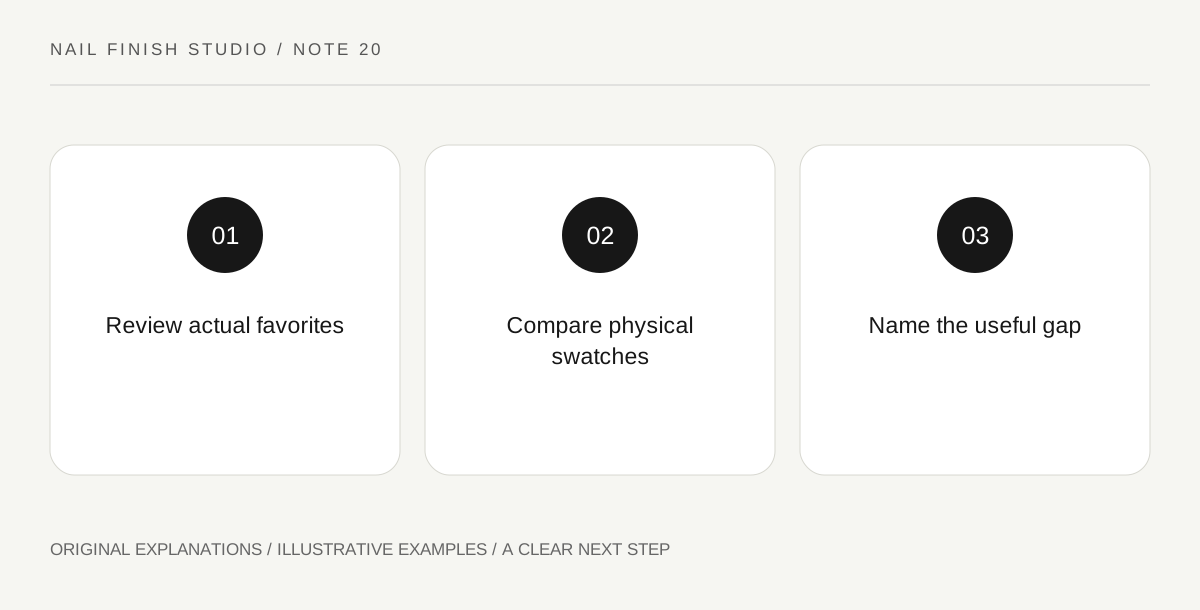
Original explanatory diagram. Read the full method and limitations below.
Start with three recent choices
List three manicures or practice combinations you enjoyed and what made each appealing. Perhaps you repeated a quiet opaque neutral, a translucent tint and a reflective accent. Keep unused aspirational colors separate from demonstrated preferences. This is not a rule against experimentation; it establishes what the current collection already does well. A purchase decision becomes clearer when it begins with actual use rather than a retailer's complete seasonal palette.
Compare the near-duplicates physically
Place labeled swatches of similar shades together in ordinary lighting. Check coverage and finish as well as color. Two pinks can look close in the bottle but serve different purposes if one is translucent and the other opaque. Conversely, two marketing names may produce a similar role in your routine. Do not declare a duplicate from a screen image alone. The useful comparison concerns the actual appearance and supported process available to you.
Write the missing role as a sentence
A useful gap might be a clearly blue dark cream finish or a supported sheer topper that works with the existing base colors. Needs something new is not a visual requirement. Ask whether a known compatible combination already provides the effect without adding another product. Keep experimentation bounded by manufacturer guidance; avoiding a purchase does not justify mixing unsuitable products or using craft materials to simulate a nail finish.
Allow a deliberate no-purchase outcome
If the collection already supports the looks you enjoy, choose one to use again. If a real gap remains, look for a product whose category, directions and appearance fit that role. Review storage condition and follow disposal guidance for products that are no longer suitable, rather than counting unusable bottles as available options. The goal is a small understandable collection you can use safely and comfortably, not a claim that a particular bottle count suits everyone.
Illustrative worked example
Illustrative scenario: a learner considers a fourth soft pink because its name sounds warmer. Comparing labeled swatches reveals that two existing products already cover the opaque and translucent looks they wear. Their actual missing role is a clearly blue dark color, which they record for a later considered choice. For now they repeat a favorite. The audit produces a specific future question instead of an automatic purchase.
Questions that come up
Is owning similar colors a mistake?
Similarity can be intentional if you enjoy the differences. The point is to recognize the choice, not impose a minimal collection or shame someone for a hobby.
Should every unused bottle be discarded?
Consider its condition, identity and instructions. You may choose to practice with a suitable product later, but do not retain ambiguous or unsuitable products simply to preserve a collection count.
References and scope
These sources support the factual background. Examples and exercises are original illustrative teaching material. References do not imply endorsement.
- FDA: Nail Care Products — Follow labels and warnings, provide ventilation and handle potentially flammable nail products safely.
- Essie: Arctic Jelly — Manufacturer description of a sheer buildable white jelly finish, not independent performance verification.
- OPI: gLITter Nail Lacquer — A manufacturer describes a particular sheer shimmer topper and its supported lacquer layering system.