Investigate a dragged color layer on a practice swatch
A finishing brush that carries color away can turn a careful surface into streaks. Pause before repeating the sequence across a full manicure. Use a suitable practice swatch to identify compatibility, preparation and handling questions, with the actual product instructions setting the boundaries of the experiment.
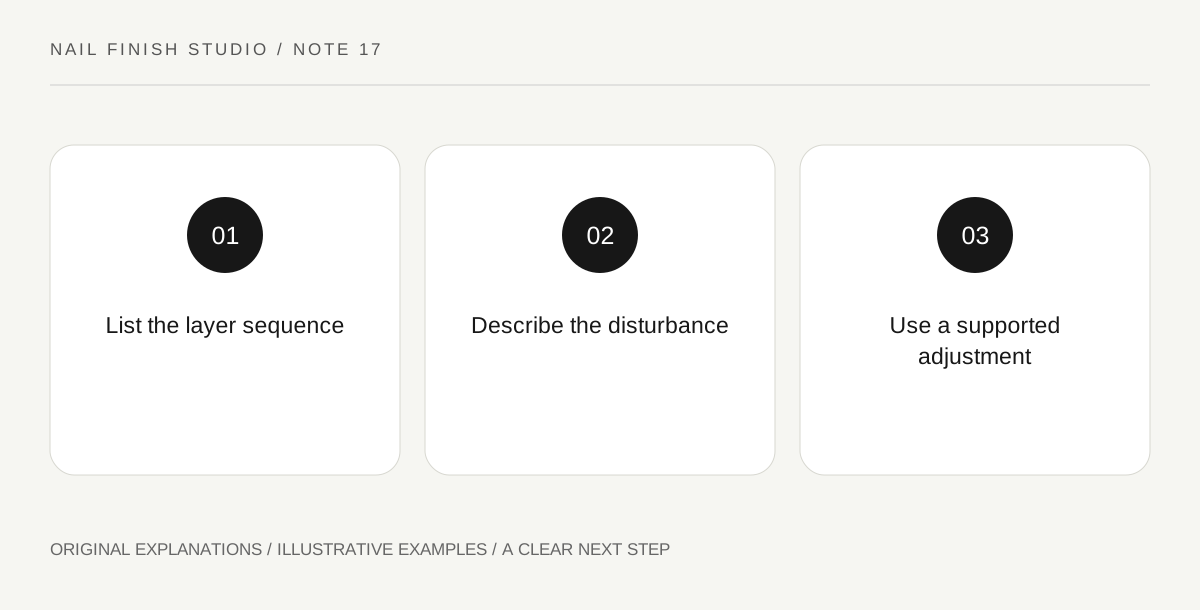
Original explanatory diagram. Read the full method and limitations below.
Identify exactly which layers are involved
Write the base, color, decorative layer if present and finishing product in order. Confirm each product category and intended system. A bottle labeled topcoat may belong to a different process from the lacquer beneath it. Check current manufacturer guidance rather than assuming every clear product is interchangeable. If compatibility is unclear, ask before application. A tidy-looking bottle collection can still contain products that were never intended to work together.
Describe the visible disturbance
Look at the practice sample and identify whether pigment has moved in a streak, a fine mark has blurred or the whole surface appears uneven. These observations are more useful than saying the topcoat ruined it. Note when the disturbance first appeared and which supported step preceded it. Avoid touching or scraping the surface to investigate. The visual record can guide a manufacturer inquiry without turning a cosmetic practice session into an unsupported chemical experiment.
Change only a supported handling detail
Read the prescribed application and interval for the exact system. If the manufacturer offers a relevant adjustment, rehearse it on a fresh practice sample while keeping other variables stable. Do not invent longer or shorter universal timing, add household solvents or substitute heat. A named quick-drying product has its own instructions; it does not establish that any color layer beneath it is ready for any amount of brush pressure at a fixed time.
Keep an alternative simple design
If the supported combination still fails, stop repeating it on the full set. Seek product guidance or choose a simpler compatible finish you understand. Preserve the practice notes so the same uncertain combination does not reappear next month. The objective is a reliable ordinary sequence, not proving that an ambitious layered design must work. Treat product reactions or concerning nail changes as reasons to stop and obtain appropriate advice, rather than as ordinary artistic setbacks.
Illustrative worked example
Illustrative scenario: a learner places a clear finishing product over a fine dark lacquer mark and sees a gray streak. Their notes reveal uncertainty about the two systems' compatibility. They pause, check the manufacturers' guidance and practice only a supported sequence. Until the question is resolved, they choose plain color for the manicure. The record describes the visible drag and products rather than claiming an unverified ingredient interaction.
Questions that come up
Should I keep adding topcoat until the streak disappears?
Extra layers can make the result harder to interpret. Stop, inspect the practice process and resolve compatibility rather than hiding the problem beneath more product.
Can one successful sample prove long wear?
It demonstrates only the observed application result. Wear, removal and individual reactions are separate questions and should not be inferred from one undisturbed practice tip.
References and scope
These sources support the factual background. Examples and exercises are original illustrative teaching material. References do not imply endorsement.
- FDA: Nail Care Products — Follow labels and warnings, provide ventilation and handle potentially flammable nail products safely.
- AAD: Manicure and Pedicure Safety — General nail-care boundaries and seeking professional care for concerning nail changes.
- OPI: RapiDry Top Coat — Application is product specific; drying-agent and topcoat names do not supply universal timing.