Learn a lacquer brush load on a practice tip before a full set
Too little lacquer can encourage repeated dragging, while too much can spread beyond the intended area. Explore the brush supplied with one conventional lacquer on suitable practice tips. The goal is to recognize a manageable load through observation, not prescribe one exact quantity for every formula and brush.
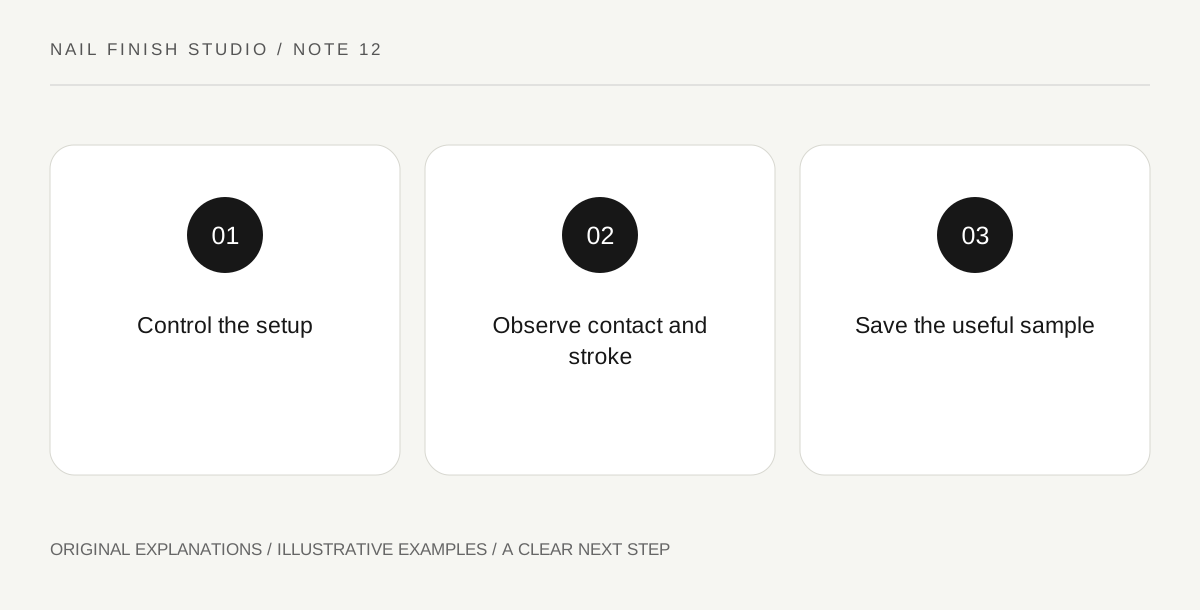
Original explanatory diagram. Read the full method and limitations below.
Keep the tools and surface constant
Choose one product, its supplied brush and comparable practice tips. Read the label before beginning and set up ventilation and safe product handling. Put the bottle on a stable protected surface away from heat and ignition sources. A controlled setup reduces accidental variables and spills. Do not add another brush or dilute the polish during the same exercise; you are learning how this particular combination behaves in ordinary supported use.
Observe the starting contact
Following the application guidance, notice what happens when the brush first touches the practice surface. Does a large bead spread quickly, or does the brush leave a dry-looking narrow track? Describe the result rather than assigning a numerical volume you cannot measure. Make the next adjustment through the maker's supported loading and wiping method. A small comparison is more informative than trying to repair one heavily flooded sample repeatedly.
Watch the middle of the stroke
Observe whether the brush continues to spread product across the intended area or begins dragging through a setting layer. The answer may involve pace and pressure as well as quantity. Keep the movement deliberate and stop when the supported layer is placed. Do not assume that pressing harder supplies more control. Write one practical observation about the point where the brush feels manageable, acknowledging that a different product or wider tip may need a fresh trial.
Transfer the lesson without overconfidence
Keep the useful practice sample and note the product identity. Natural nails introduce different sizes and contours, so move carefully and follow appropriate nail-care guidance. Avoid contact with surrounding skin and stop if a product causes a reaction. A practice success means you learned something about handling; it does not establish professional competence or guarantee identical results on every finger. Continue with a simpler design while the basic movement becomes familiar.
Illustrative worked example
Illustrative scenario: a beginner alternates between an almost dry brush and a large bead of lacquer. On comparable practice tips they change only the supported loading action and observe the first contact and middle stroke separately. One sample becomes easier to control without repeated passes. They save it with a short note about the brush behavior instead of inventing a universal drop count.
Questions that come up
Can I count drops on every brush?
Brush shape and formula vary, and a visible bead is not a standardized measurement. Observe controlled behavior while following the actual product method.
Should I practice on skin to learn control?
Use suitable practice surfaces and avoid unnecessary skin contact. The learning target is the painted boundary, not tolerance of exposure to nail products.
References and scope
These sources support the factual background. Examples and exercises are original illustrative teaching material. References do not imply endorsement.
- FDA: Nail Care Products — Follow labels and warnings, provide ventilation and handle potentially flammable nail products safely.
- AAD: Manicure and Pedicure Safety — General nail-care boundaries and seeking professional care for concerning nail changes.