Simplify a manicure plan for the hand that is harder to paint
A design can look straightforward when drawn with your preferred hand and become frustrating when the roles reverse. Plan both sides before applying lacquer. Use paper or practice tips to identify which movements remain manageable, then simplify deliberately without making the second hand feel like an unfinished version.
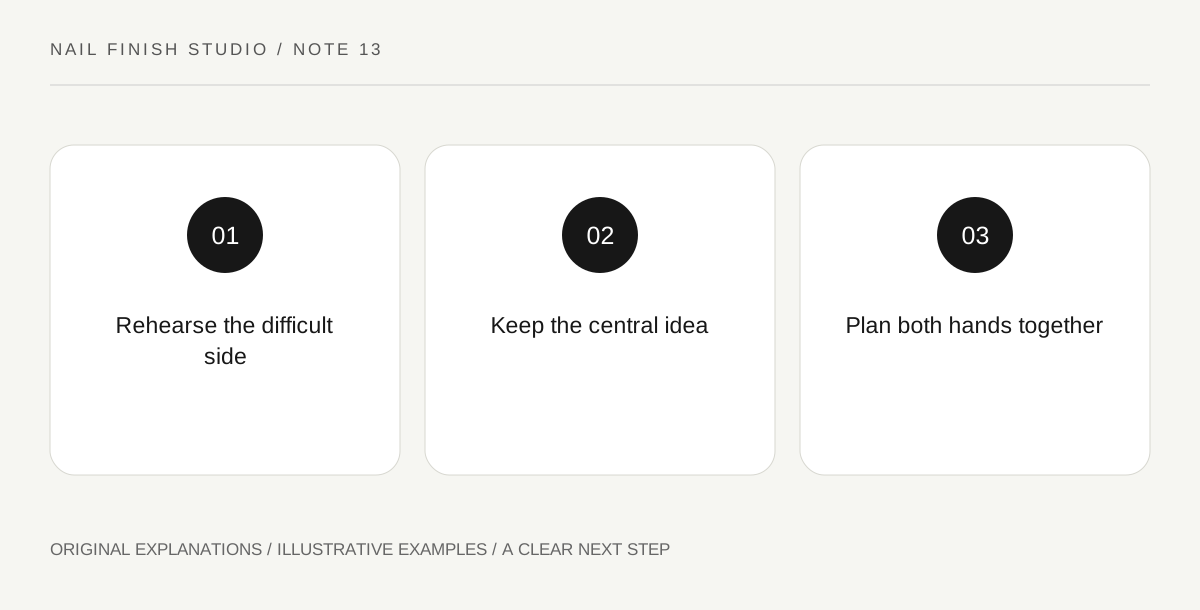
Original explanatory diagram. Read the full method and limitations below.
Test the difficult movement first
Sketch the intended design using the hand you find less controlled. Begin on paper or an appropriate practice surface rather than discovering the difficulty halfway through a manicure. Notice whether the problem is a tiny curved line, repeated dots or simply holding the surface steady. Name the action precisely. A broad impression that one hand is bad at art gives you fewer useful choices than identifying one movement that needs simplification.
Reduce detail while preserving the idea
Choose the design's central feature and remove details that do not carry it. A color relationship or finish can remain recognizable without a complicated motif. Compare a simpler version with the original sketch at ordinary hand distance. The goal is not to hide a mistake but to define a coherent design that both hands can support. Avoid making every nail more complex just because one successful practice mark tempted you to expand the plan.
Choose a stable permitted working arrangement
Use a comfortable supported position and keep the product on a stable protected surface. Rehearse where the hand and practice tip rest so you are not reaching across an open bottle. Keep the movement within the product's supported method and avoid skin contact. If your grip or dexterity makes the task uncomfortable, choose an easier option or appropriate help rather than pushing through pain to complete a decorative goal.
Let coordination replace exact duplication
The two hands can share a palette or finish without carrying identical tiny marks. Draw the full arrangement and check whether it feels intentional together. A plain finish on one side and restrained detail on the other can be a deliberate composition if that is what you choose. Record the final plan before starting so a late improvisation does not create extra work. Success is a manageable complete design, not proof of perfect symmetry.
Illustrative worked example
Illustrative scenario: a learner plans a small curved motif on every nail but finds the nonpreferred-hand sketch inconsistent. They preserve the two chosen colors and use a simpler finish arrangement across both hands. The revised paper plan looks complete from normal distance and is easier to rehearse. They choose it before applying lacquer, avoiding a rushed attempt to force the original detail onto the second hand.
Questions that come up
Must both hands be identical?
No. Shared color, finish or rhythm can provide coherence. Exact duplication is one design option rather than a requirement that should make the task uncomfortable.
Should I keep practicing through hand pain?
Stop an uncomfortable task and seek appropriate guidance if needed. Decorative practice should be adapted to your comfort and abilities, not treated as a reason to ignore symptoms.
References and scope
These sources support the factual background. Examples and exercises are original illustrative teaching material. References do not imply endorsement.
- FDA: Nail Care Products — Follow labels and warnings, provide ventilation and handle potentially flammable nail products safely.
- AAD: Manicure and Pedicure Safety — General nail-care boundaries and seeking professional care for concerning nail changes.